Card News

NEWS
KOTI - Korea Transport institute
Feeds and Updates
People-Centered Mobility, Transforming Cities - Lessons from Europe’s Mobility Hubs for Korea’s Future –
November 25 2025
-
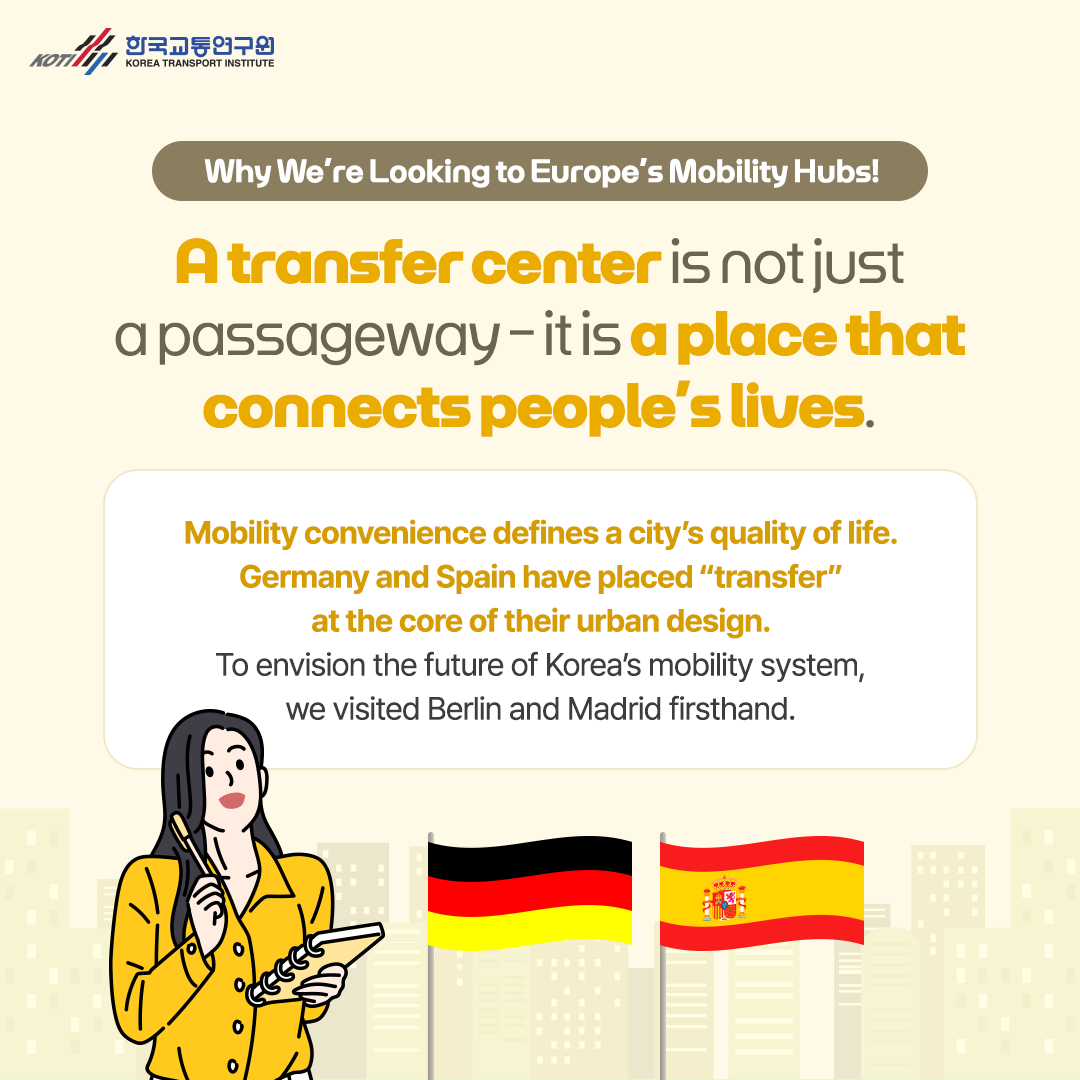
Why We’re Looking to Europe’s Mobility Hubs!
“A transfer center is not just a passageway — it is a place that connects people’s lives.”
Mobility convenience defines a city’s quality of life.
Germany and Spain have placed “transfer” at the core of their urban design.
To envision the future of Korea’s mobility system, we visited Berlin and Madrid firsthand.
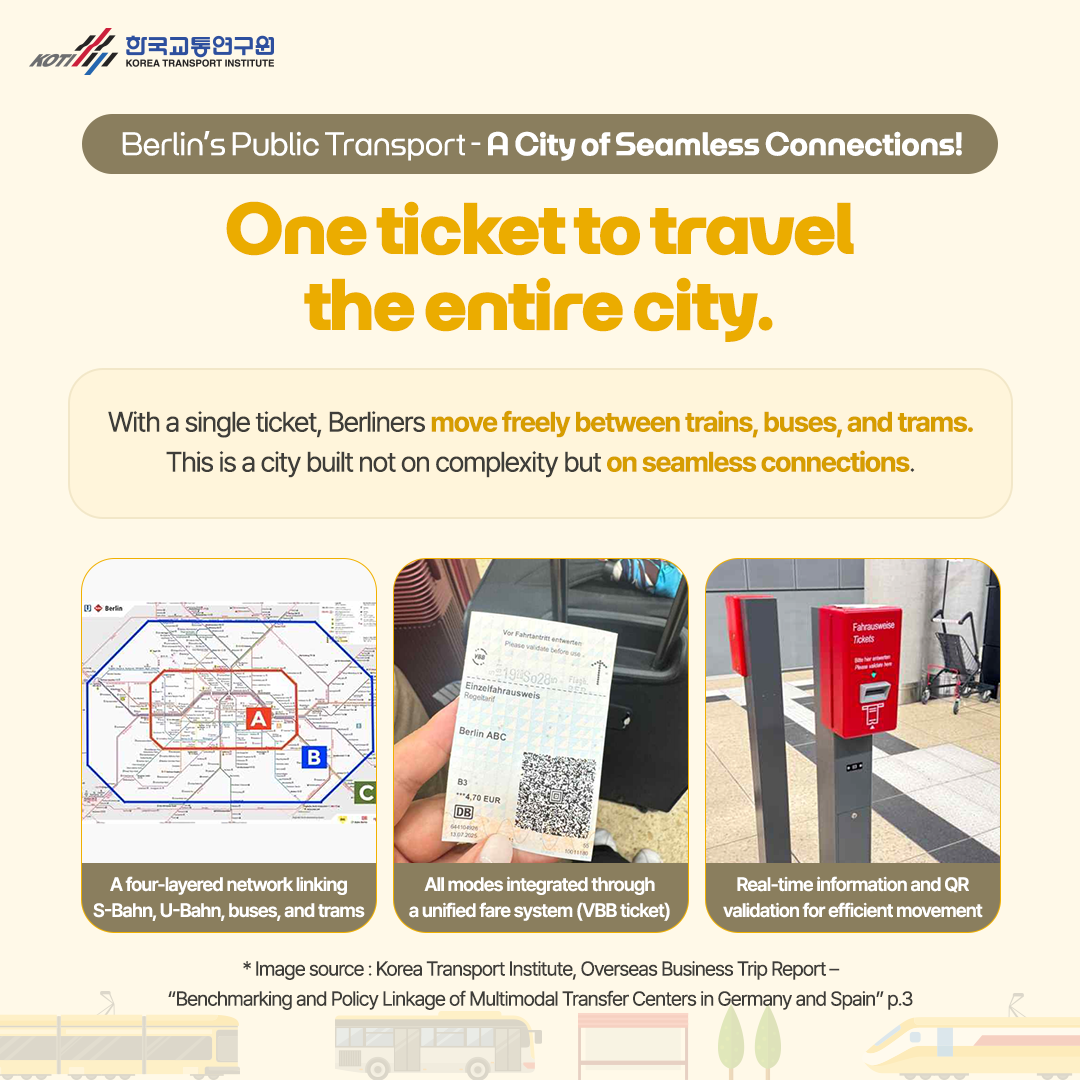
Berlin’s Public Transport – A City of Seamless Connections
“One ticket to travel the entire city.”
With a single ticket, Berliners move freely between trains, buses, and trams.
This is a city built not on complexity but on seamless connections.
- A four-layered network linking S-Bahn, U-Bahn, buses, and trams
- All modes integrated through a unified fare system (VBB ticket)
- Real-time information and QR validation for efficient movement
* Image source : Korea Transport Institute, Overseas Business Trip Report – “Benchmarking and Policy Linkage of Multimodal Transfer Centers in Germany and Spain,” p.3
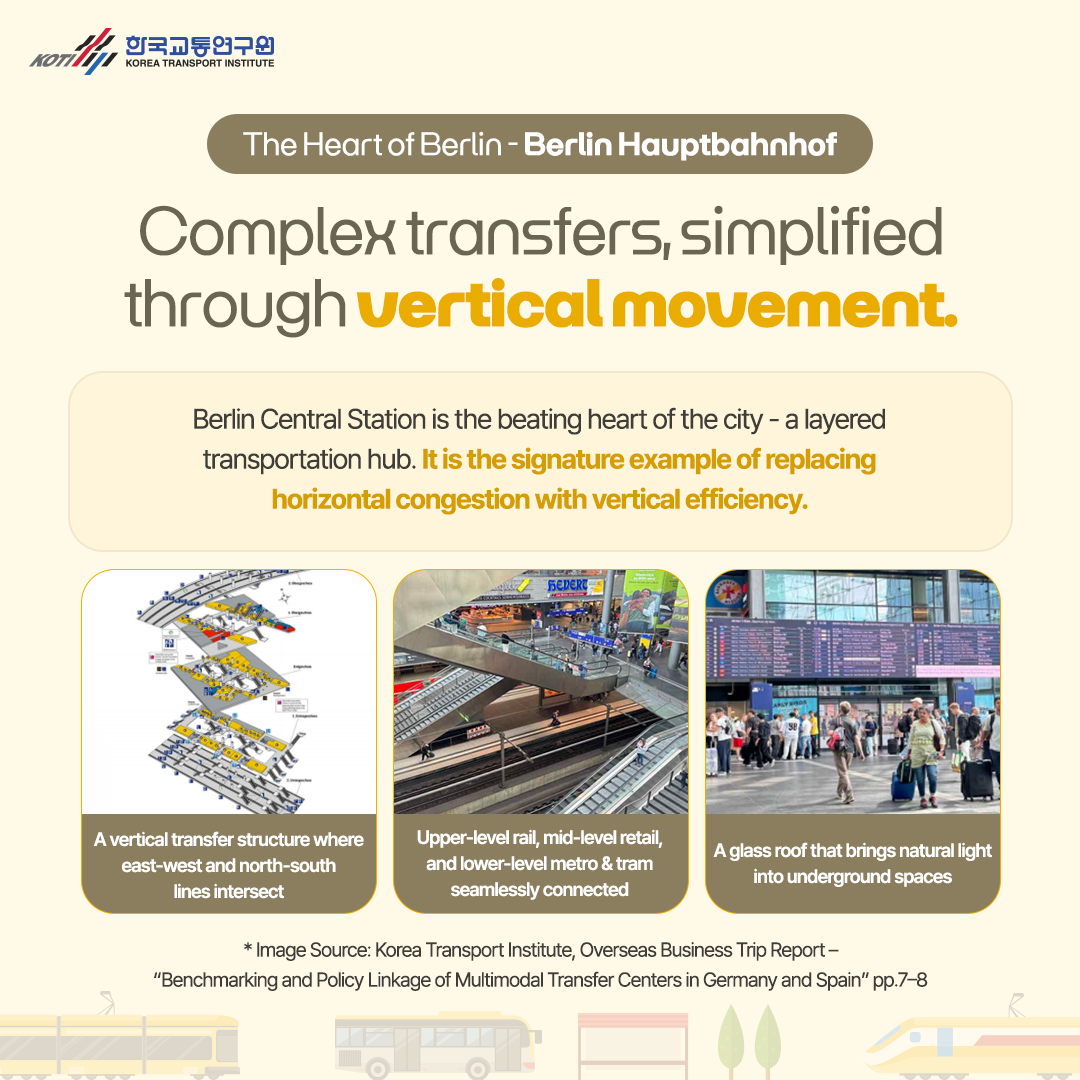
The Heart of Berlin – Berlin Hauptbahnhof
“Complex transfers, simplified through vertical movement.”
Berlin Central Station is the beating heart of the city — a layered transportation hub.
It is the signature example of replacing horizontal congestion with vertical efficiency.
- A vertical transfer structure where east-west and north-south lines intersect
- Upper-level rail, mid-level retail, and lower-level metro & tram seamlessly connected
- A glass roof that brings natural light into underground spaces
* Image Source: Korea Transport Institute, Overseas Business Trip Report – “Benchmarking and Policy Linkage of Multimodal Transfer Centers in Germany and Spain,” pp.7–8
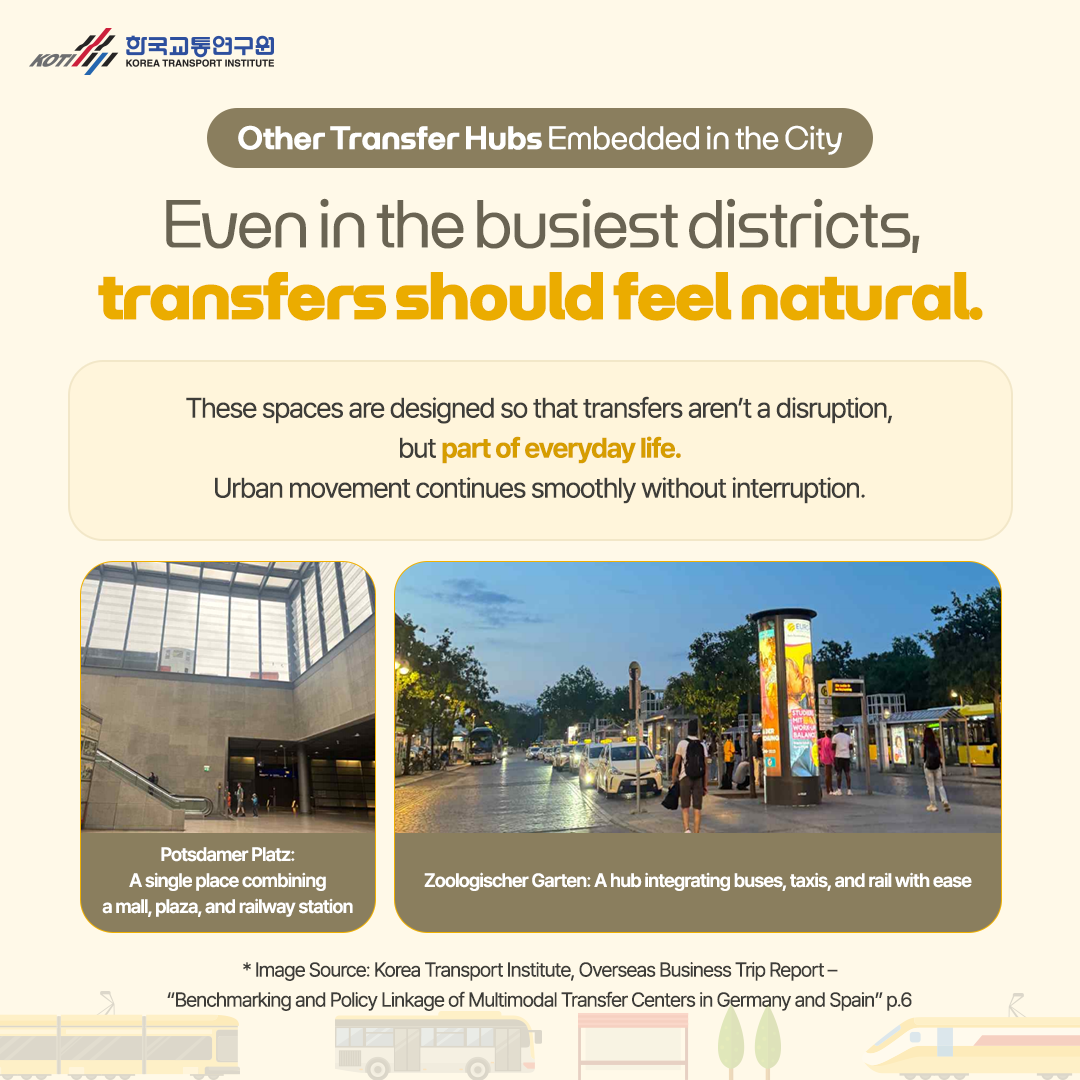
Other Transfer Hubs Embedded in the City
“Even in the busiest districts, transfers should feel natural.”
These spaces are designed so that transfers aren’t a disruption, but part of everyday life.
Urban movement continues smoothly without interruption.
- Potsdamer Platz: A single place combining a mall, plaza, and railway station
- Zoologischer Garten: A hub integrating buses, taxis, and rail with ease
* Image Source: Korea Transport Institute, Overseas Business Trip Report – “Benchmarking and Policy Linkage of Multimodal Transfer Centers in Germany and Spain,” p.6
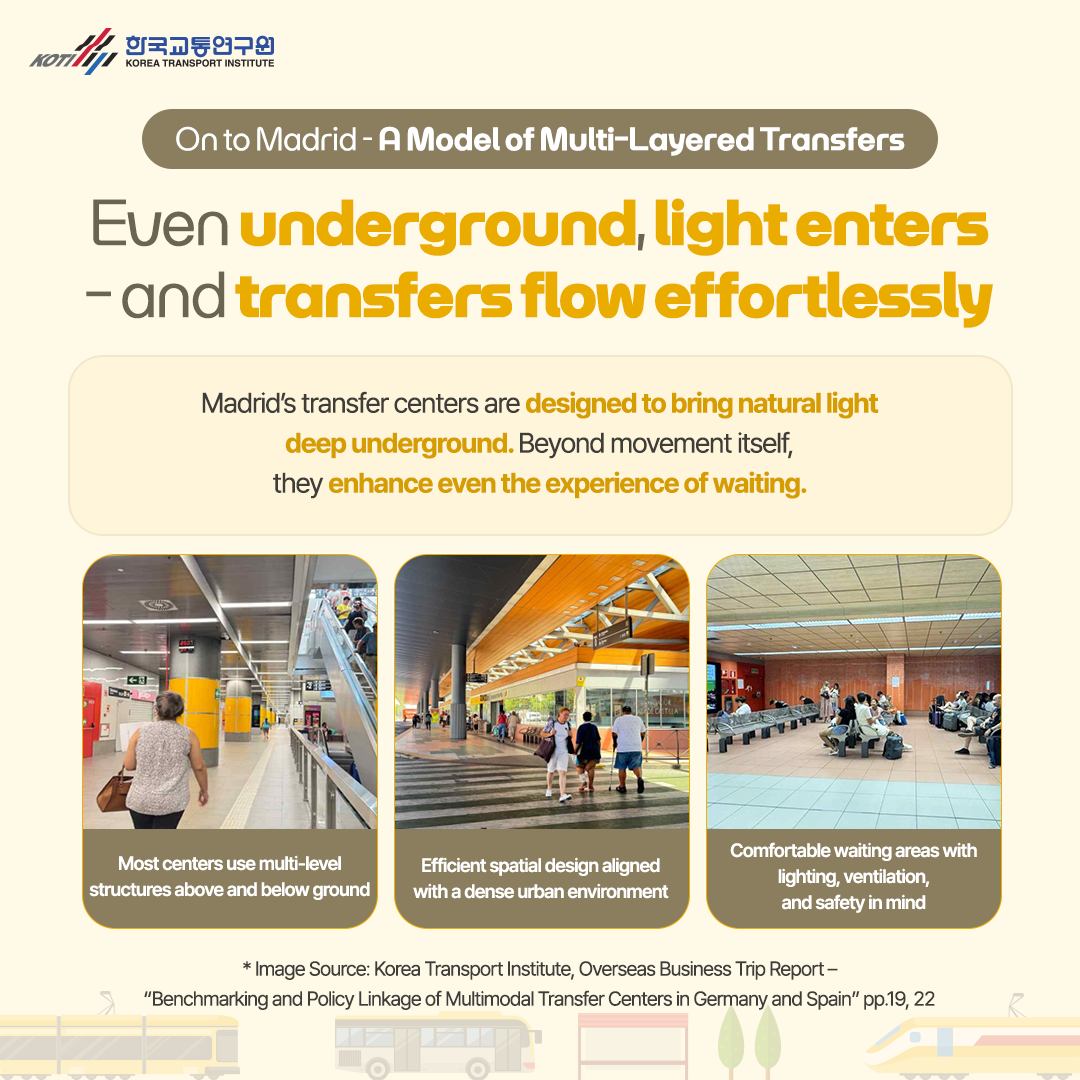
On to Madrid – A Model of Multi-Layered Transfers
“Even underground, light enters — and transfers flow effortlessly.”
Madrid’s transfer centers are designed to bring natural light deep underground.
Beyond movement itself, they enhance even the experience of waiting.
- Most centers use multi-level structures above and below ground
- Efficient spatial design aligned with a dense urban environment
- Comfortable waiting areas with lighting, ventilation, and safety in mind
* Image Source: Korea Transport Institute, Overseas Business Trip Report – “Benchmarking and Policy Linkage of Multimodal Transfer Centers in Germany and Spain,” pp.19, 22
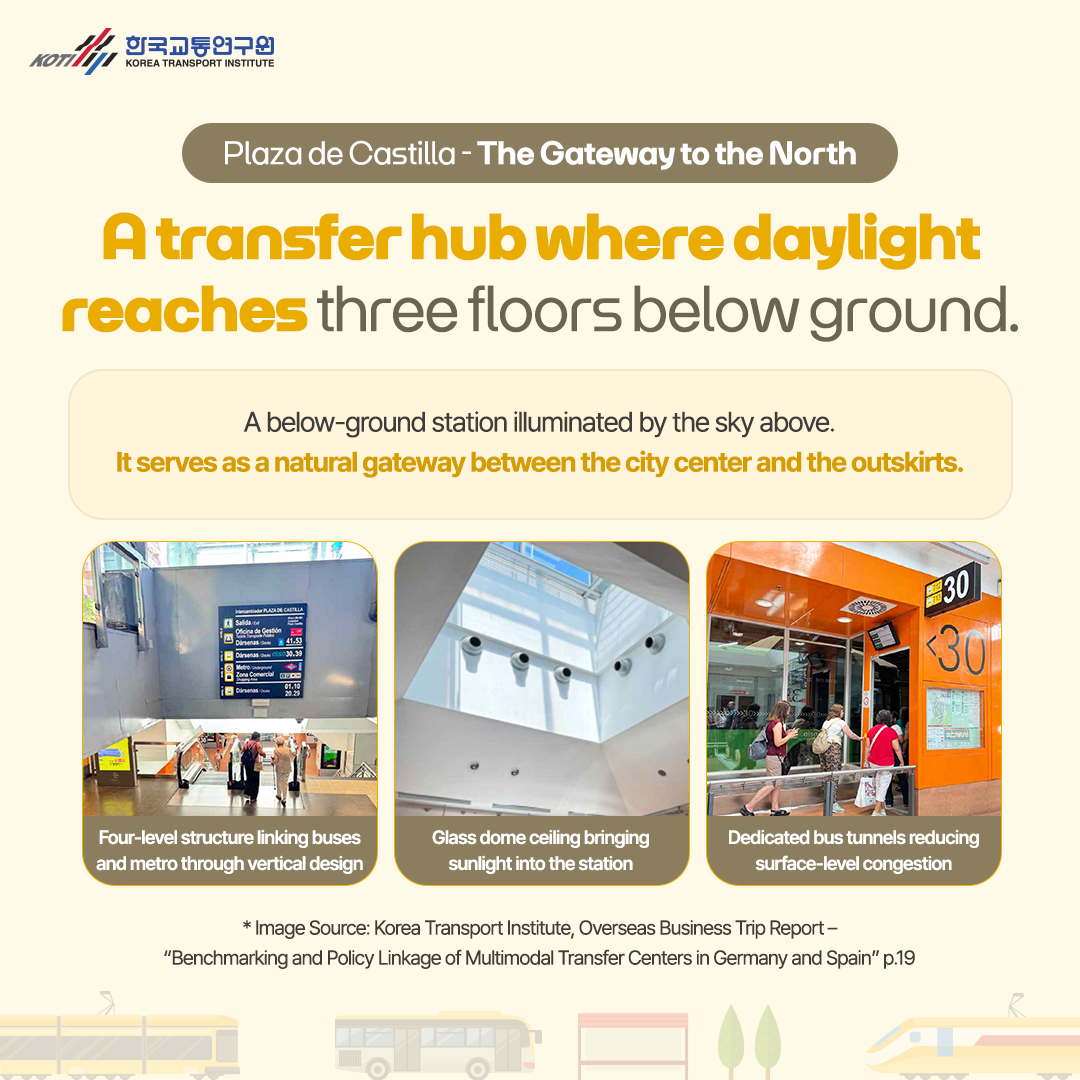
Plaza de Castilla – The Gateway to the North
“A transfer hub where daylight reaches three floors below ground.”
A below-ground station illuminated by the sky above.
It serves as a natural gateway between the city center and the outskirts.
- Four-level structure linking buses and metro through vertical design
- Glass dome ceiling bringing sunlight into the station
- Dedicated bus tunnels reducing surface-level congestion
* Image Source: Korea Transport Institute, Overseas Business Trip Report – “Benchmarking and Policy Linkage of Multimodal Transfer Centers in Germany and Spain,” p.19
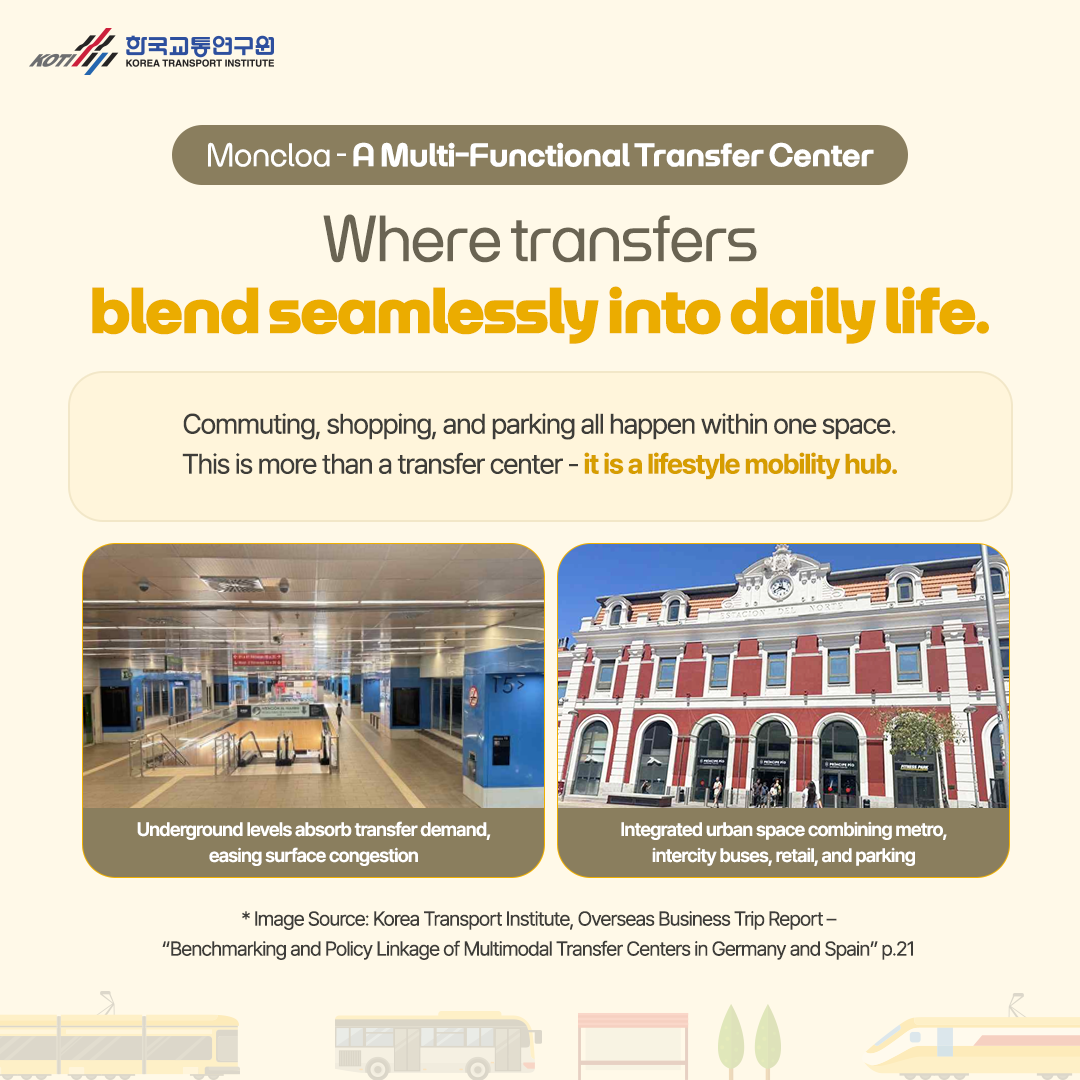
Moncloa – A Multi-Functional Transfer Center
“Where transfers blend seamlessly into daily life.”
Commuting, shopping, and parking all happen within one space.
This is more than a transfer center — it is a lifestyle mobility hub.
- Underground levels absorb transfer demand, easing surface congestion
- Integrated urban space combining metro, intercity buses, retail, and parking
* Image Source: Korea Transport Institute, Overseas Business Trip Report –“Benchmarking and Policy Linkage of Multimodal Transfer Centers in Germany and Spain,” p.21
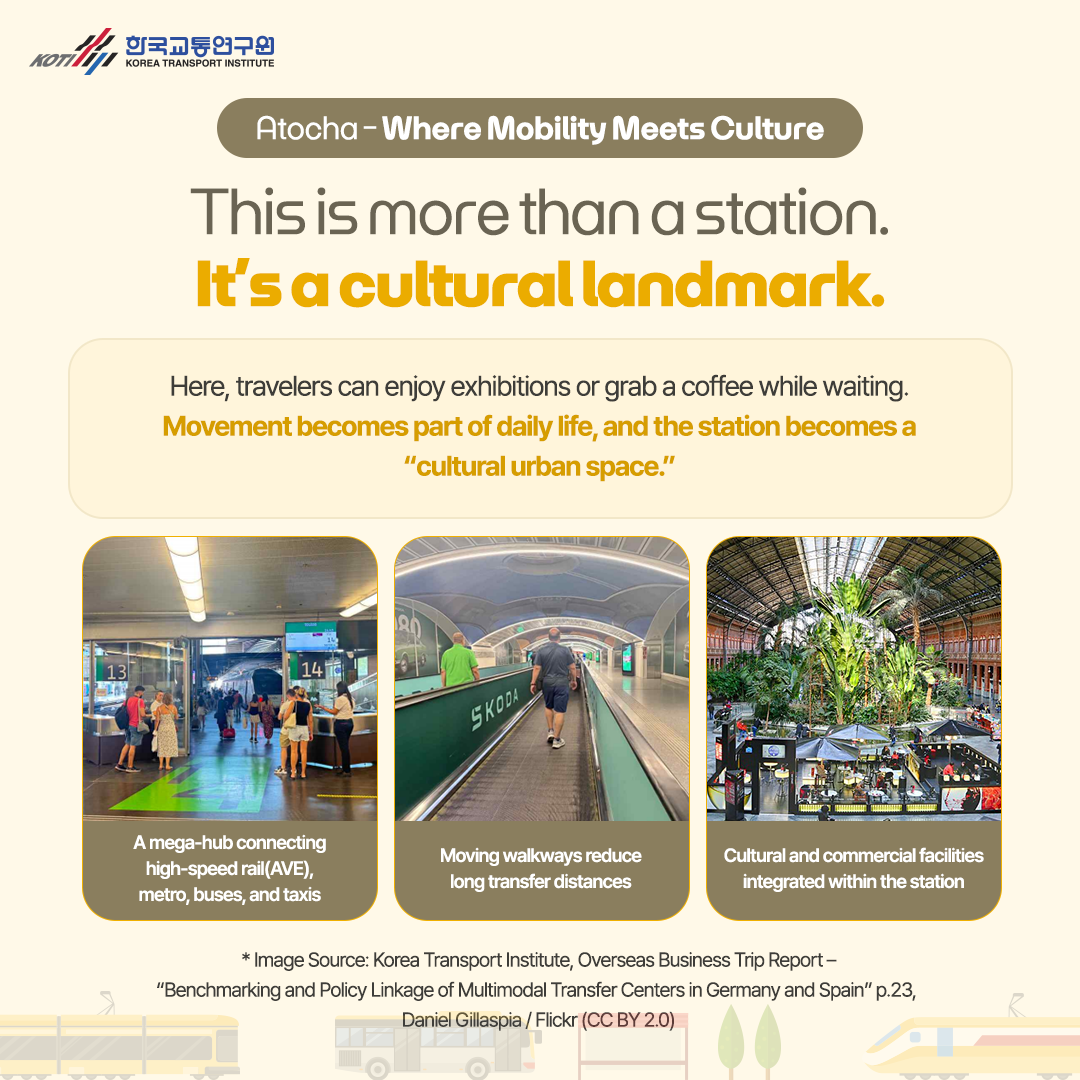
Atocha - Where Mobility Meets Culture
“This is more than a station. It’s a cultural landmark.”
Here, travelers can enjoy exhibitions or grab a coffee while waiting.
Movement becomes part of daily life, and the station becomes a “cultural urban space.”
- A mega-hub connecting high-speed rail (AVE), metro, buses, and taxis
- Moving walkways reduce long transfer distances
- Cultural and commercial facilities integrated within the station
* Image Source: Korea Transport Institute, Overseas Business Trip Report – “Benchmarking and Policy Linkage of Multimodal Transfer Centers in Germany and Spain,” p.23
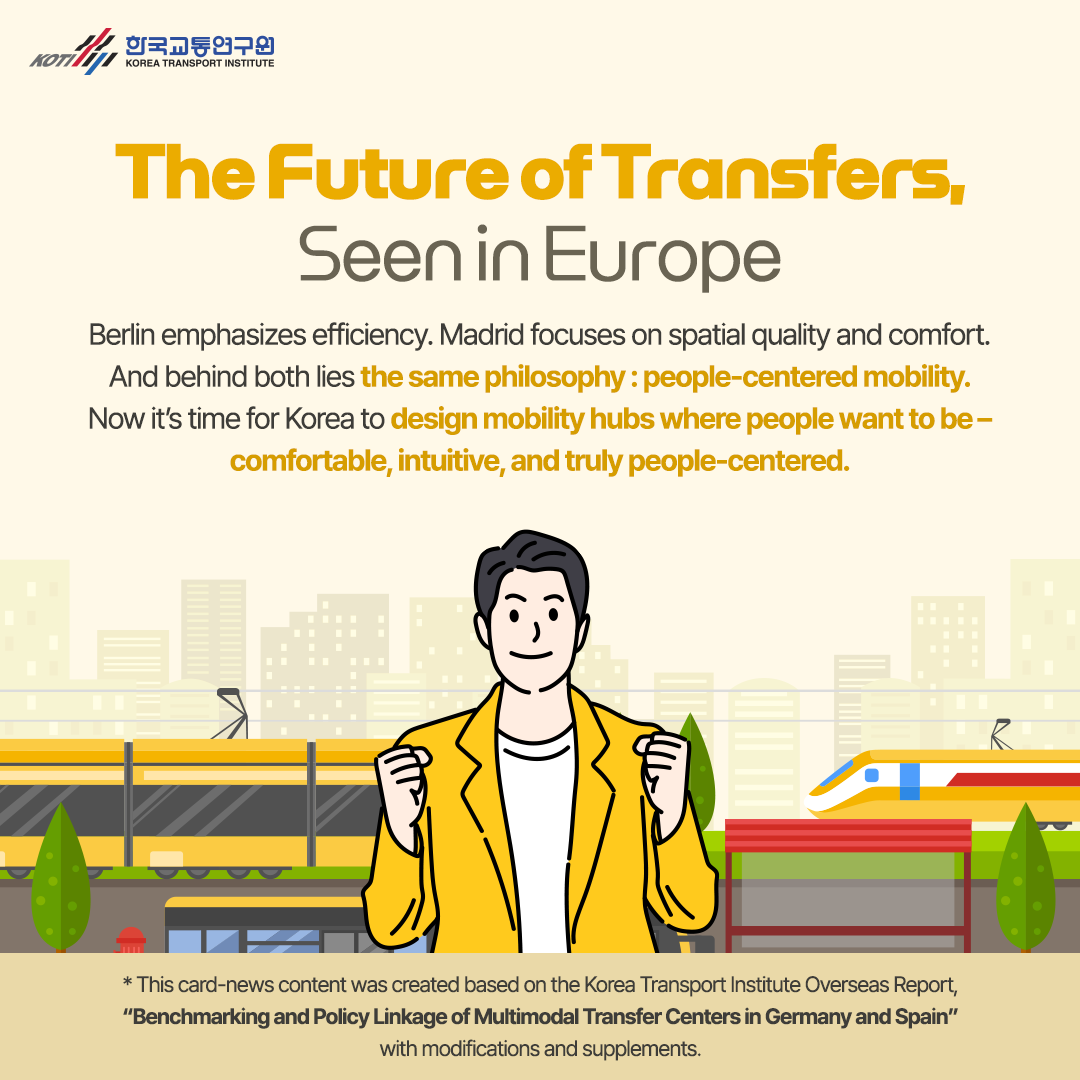
Berlin emphasizes efficiency.
Madrid focuses on spatial quality and comfort. And behind both lies the same philosophy: people-centered mobility.
Now it’s time for Korea to design mobility hubs where people want to be – comfortable, intuitive, and truly people-centered.
* This card-news content was created based on the Korea Transport Institute Overseas Report, “Benchmarking Germany and Spain’s Multimodal Transfer Centers,” with modifications and supplements.