Policy Report

RESEARCH
KOTI - Korea Transport institute
Oil Price and Travel Demand
- Date
August 21 2009
- Page(s)
page(s)
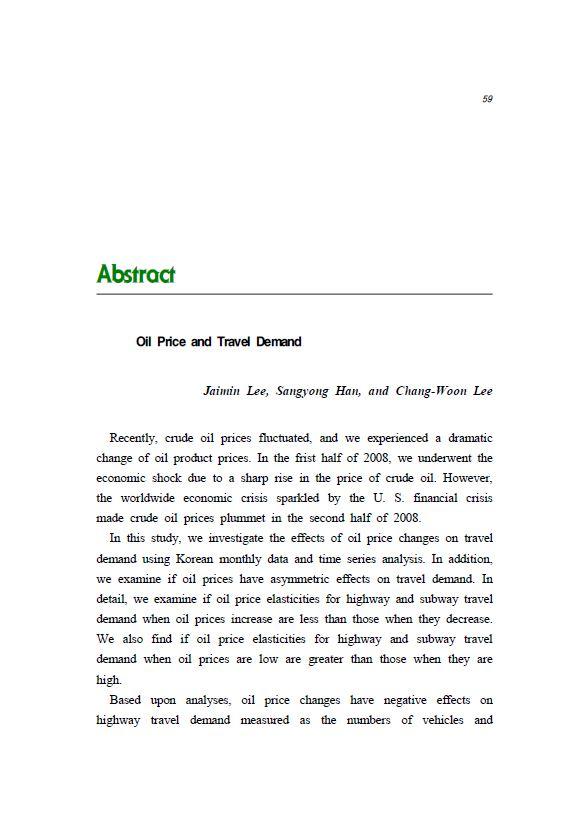
Recently, crude oil prices fluctuated, and we experienced a dramatic change of oil product prices. In the frist half of 2008, we underwent the economic shock due to a sharp rise in the price of crude oil. However, the worldwide economic crisis sparkled by the U. S. financial crisis made crude oil prices plummet in the second half of 2008.
In this study, we investigate the effects of oil price changes on travel demand using Korean monthly data and time series analysis. In addition, we examine if oil prices have asymmetric effects on travel demand. In detail, we examine if oil price elasticities for highway and subway travel demand when oil prices increase are less than those when they decrease. We also find if oil price elasticities for highway and subway travel demand when oil prices are low are greater than those when they are high.
Based upon analyses, oil price changes have negative effects on highway travel demand measured as the numbers of vehicles and vehicle-kilometers and positive effects on subway travel demand measured as the numbers of passengers and passenger-kilometers.
In highway travel demand, the oil price elasticities when oil prices are low are greater than those when they are high. Chow test results show that we have to differentiate the low oil price periods from the high oil price periods. There are asymmetric relations between oil prices and highway travel demand.
However, even if the oil price elasticities of highway travel demand when oil prices drop are greater than those when they rise, we do not need to distinguish the decreasing oil price periods from the increasing oil price periods according to Chow test results.
Finally, we can say that there are asymmetric effects of oil price changes when oil prices are low or high. The agents to use private cars in the highway when oil prices are low-from January 2000 to June 2004 responded about five or seven times as sensitive as when oil prices are high-from July 2004 to December 2008.
The oil price elasticities of subway travel demand when oil prices drop are greater than those when they rise.
However, the oil price elasticities of subway travel demand when oil prices are low are not greater than those when they are high, which is not our expectation about asymmetric characteristics. We infer that it is due to the effects of Mass Transit System Change executed in the city of Seoul in July 2004.
We add the dummy variable to represent Mass Transit System Change to our model. According to the analysis, Mass Transit System Change increases the subway travel demand by about 4%. Chow test results show that we do not need to differentiate the decreasing oil price periods from the increasing oil price periods.
Thus, we can not say that there are asymmetric effects of oil price changes on subway travel demand when oil prices are low or high or when oil prices drop or rise.
In addition, the long-run elasticities of subway travel demand are less than those of highway travel demand. Travelers to use subway respond less sensitively to oil price changes than those to pass highway. It gives us a hint that oil prices policies do not have big effects on the use of public transportation.
Considering recent business recovery, the differences of the elasticities of highway and subway travel demand, and the effects of Mass Transit System Change in the city of Seoul, we have to mix the tax policies with expanding or improving public transportation facilities to decrease the road traffic volumes and increase the use of public transportation