World Brief

RESEARCH
KOTI - Korea Transport institute
KOTI World Brief Vol.43
- Date
December 31 2012
- Page(s)
16 page(s)
Focus
Facilitating the Use of Gyeongin Waterway to Improve Logistics Networks in the Capital Region
〇 Background and Purpose of the Study
- Measures need to be drawn up to use the Gyeongin Waterway in a way that can facilitate cargo transportation and rationalize logistics networks in the national capital region.
〇 Evaluation of the Logistics System in the National Capital Region
- Serious level of cargo traffic concentration in the national capital region
- Cargo traffic bottlenecks in routes centering on the Incheon-Seoul corridor
〇 Prospects of Using Gyeongin Waterway as Logistics Infrastructure
- Low level of economic feasibility due to limitations in cargo demand creation
- Logistics restrictions related to the waterway’s tourism/leisure functions
- Need to identify products suitable for waterway transport by considering environmental restrictions and the navigation channel’s physical limitations
- Agricultural imports from China and automobiles cited as product categories suitable for waterway transport
〇 Application of Gyeongin Waterway as Integrated Multimodal Logistics Network
- Building an Integrated Multimodal Transport Network for the Capital Area
- Turning Gimpo Terminal into a New-Concept Integrated Logistics Hub
- Building an Auto Cluster at Incheon Terminal
- Promoting Linkage with Domestic Coastwise Shipping
- Establishing a Direct Shipping System for Trade with China
Trends 1
Transportation Management Measures for the Parkway Along the Gyeongin Ara Waterway
〇 Necessity for Transport Management Measures for the Parkway Along the Gyeongin Ara Waterway
- The parkway is a two-lane straight road that currently has no speed limits, running parallel with the Incheon Airport Expressway from Oryeo-dong, Seo-gu, Incheon to the Olympic Road starting point in Gaehwa-dong, Gangseo-gu, Seoul.
- Without speed or traffic volume control measures, the parkway would lose its function as a tourism road and suffer from severe traffic congestion that could have a negative impact on efforts to ensure the safety of waterway tourists.
- On the basis of travel demand analysis, this study proposes various measures aimed at controlling the volume of traffic passing through the parkway and eventually improving the comfort level and ensuring travel efficiency of the road.
〇 Results of Travel Demand Analysis for the Parkway
- Analysis was conducted by setting various conditions such as the speed limit, truck travel ban and closure of some segments of the road.
- According to the analysis, if control measures were not taken, the service level of the parkway would be rated as “D” or lower, indicating that it would end up providing very poor services in terms of comfort and travel efficiency.
- However, imposition of restrictions employed in advanced countries such as a 30km/h speed limit and a truck travel ban would increase the road’s service level to “A,” ensuring the prospects of providing fairly good services in terms of comfort and travel efficiency.
〇 Transport Management Measures for the Parkway
- To improve the comfort level and travel efficiency of the parkway, this study suggests installing point-to-point speed enforcement cameras and employing traffic-calming methods. It also proposes installing roadside parking lots by considering their connectivity to crosswalks as part of efforts to improve the safety of tourists and their accessibility to the waterway.
Trends 2
Applicability of the Gyeongin Ara Waterway for Opening a New Korea-China Trade Route
〇 Background and Purpose of the Study
- Developing a global logistics hub to cope with the growth of the Pan Yellow Sea Economic Bloc and the emerging Northeast Asian economic era.
- Maximizing the applicability of the Gyeongin Waterway in building a logistics network for direct trade routes between Korea and China.
〇 Current Status of Korea-China Trade
- Since normalization of ties between Korea and China in 1992, Korea’s exports to and imports from China have expanded by 23 and 18 times, respectively (based on 2010 statistics).
- China became Korea’s largest trading partner in 2010.
- As of 2010, the national capital region accounted for 68.6% of the imports and 41.4% of the exports in Korea’s trade with China, in terms of dollar value. In terms of cargo throughput, the capital region accounted for 48.3% of the imports and 14% of the exports.
〇 Directions for Improving Logistics Networks for Trade with China
- Consumption of imports from China is centered in the capital region. However, under an ineffective logistics system, a considerable portion of the Chinese goods are imported through the port of Busan and transported by road all the way to the capital area.
- Need to convert the current three-stage transport structure (Chinese inland areas → Chinese ports → marine transport → Korean ports → Seoul) into a one-stage direct system (Chinese inland areas → marine/waterway transport → Seoul)
- The shift would lead to a reduction in transport distance by 653 km between the Korean capital region and the Chinese ports of Dalian, Tianjin, Weihai, Qingdao and Shanghai, as well as a decrease in the transport burden by an estimated 260 billion tons/km a year (based on the 2007 statistics on the traffic of imported Chinese cargo).
- Agricultural imports from China are being considered as a category of products suitable for transport via the Ara Waterway.
〇 Measures to Facilitate the Use of the Gyeongin Waterway as a Korea-China Trade Route
- Pursuing a project to turn Gimpo Terminal into a new-concept integrated logistics hub (specialized for fresh food and leading-edge industries).
- Establishing a multimodal transport system through a reinforcement of connection networks involving coastwise shipping and railways.
- Creating demand through exploring new Korea-China trade routes .
- Devising measures to reorganize terminal operating systems and provide various types of support (incentives such as tax support and relaxation of regulations).
News
2012 Leaders in Urban Transport Planning Program in Seoul
The 3rd International Public Transportation Forum: Public Transport in Our Life, etc.
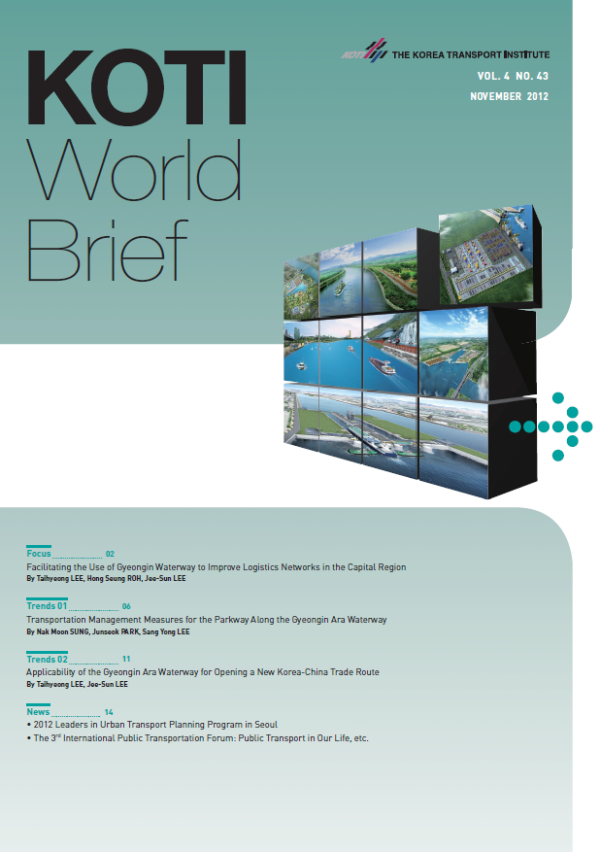
Focus
Facilitating the Use of Gyeongin Waterway to Improve Logistics Networks in the Capital Region
Trends 1
Transportation Management Measures for the Parkway Along the Gyeongin Ara Waterway
Trends 2
Applicability of the Gyeongin Ara Waterway for Opening a New Korea-China Trade Route
News
2012 Leaders in Urban Transport Planning Program in Seoul
The 3rd International Public Transportation Forum: Public Transport in Our Life, etc.