연구개발적립금보고서
사회·정책적 환경에 부합하는 주제를 선정하고, 그 연구결과물을 수록한 교통 현안 관련 자체 보고서입니다.

연구
KOTI 교통연구원
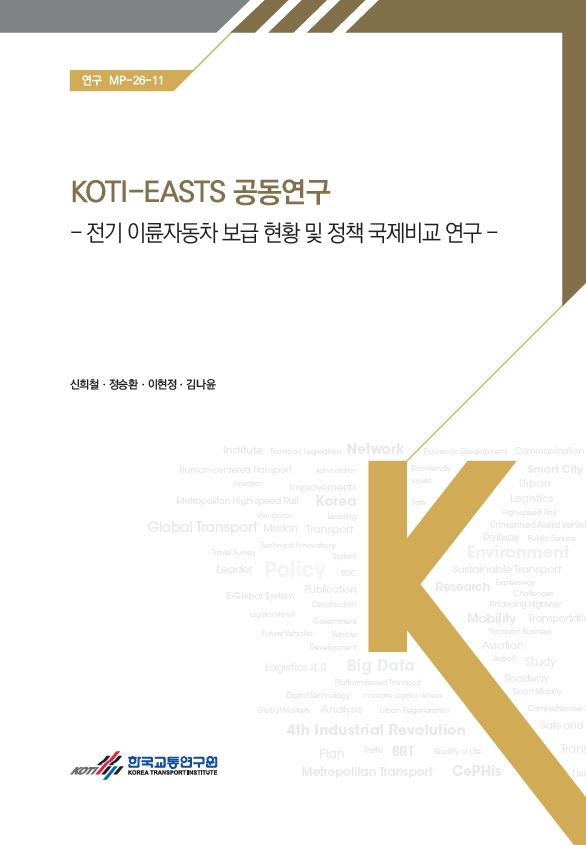
KOTI-EASTS 공동연구–전기 이륜자동차 보급 현황 및 정책 국제비교 연구
- 발간일
2026.03.31
- 저자
신희철,정승환,이현정,김나윤
- 언어 / 페이지수
영문 / 288 Page
#전기이륜차
#보급정책
#탄소중립
#국가간 비교분석
#친환경 모빌리티
-
이 연구는 한국을 포함한 아시아 5개국을 중심으로 국가별 전기이륜차의 보급 현황 및 정부 정책을 기술하고, 국가별 비교 분석을 통해 정책적 함의와 공동의 전기이륜차 활성화 방안을 모색하였다.
<이하 원문 참조> -
국문 요약 i
Summary ix
Chapter 1
Introduction 1
Section 1. Research Background and Purpose 3
1. Background 3
2. Purpose 6
Section 2. Research Scope and Methodology 7
1. Research Scope 7
2. Research Methodology 7
3. Review of Previous Studies and Differentiation 8
Section 3. Operational Definitions and Framework for International Comparative Analysis 10
1. Classification Criteria for E2Ws 10
2. Framework for International Comparative Analysis 17
Chapter 2
Global E2W Market and Macroeconomic Environment of Target Countries 21
Section 1. The Necessity of the Transition to Eco-friendly Mobility 23
Section 2. Global E2W Market Trends 27
1. Global E2W Market 27
2. Market and Export Trends in China 30
3. Market and Export Trends in India 35
Section 3. Socioeconomic Status and Transportation Infrastructure by Target Country 40
1. Demographic and Economic Status 40
2. Energy Status 42
3. Transportation Infrastructure Status 44
4. E2W Industry Trends 46
Chapter 3
Deployment Trends and Policy Landscape of E2Ws in Korea 49
Section 1. Current Status of E2W Penetration 51
1. E2W Registration Metrics and Fleet Size 51
2. Deployment Status of Charging Infrastructure 55
3. Industry Landscape and Market Dynamics 57
Section 2. Regulatory Frameworks and Policy Developments 61
1. Legal Frameworks and Traffic Safety Regulations 61
2. Financial Support and Fiscal Incentives 75
3. Technical Standards and Certification Policies 79
Section 3. Domestic Issues Related to E2W Deployment 80
1. Lack of Price Competitiveness 80
2. Charging Constraints 82
3. Vulnerability of the Industry Structure 83
4. Lack of Mid- to Long-Term Plans 84
Section 4. Directions for Improvement to Expand Deployment of E2Ws 85
1. Support for Enhancing Competitiveness 85
2. Improving Accessibility to Charging Infrastructure 86
3. Industry Revitalization 87
4. Establishment of Mid- to Long-Term Deployment Plans 88
5. Strengthening Regulations on Gasoline-Powered Motorcycles 91
6. Improvement of E2W Management 92
Chapter 4
Deployment Trends and Policy Landscape of E2Ws in Taiwan 95
Section 1. Current Status of E2W Penetration and Ecosystem Dynamics 97
1. National Carbon Neutrality Roadmap 97
2. E2W Registration Metrics and Fleet Size 99
3. Deployment Status of Charging Infrastructure 105
4. Industry Landscape and Market Dynamics 109
Section 2. Regulatory Frameworks and Policy Developments 110
1. Legal Frameworks and Institutional Governance 110
2. Financial Support and Fiscal Incentives 113
3. Technical Standards and Certification Policies 115
4. Traffic Safety Regulations 116
Section 3. Strategic Implications and Policy Recommendations 118
1. Policy 119
2. Technology 121
3. Industry 121
4. Market 122
Chapter 5
Deployment Trends and Policy Landscape of E2Ws in Japan 123
Section 1. Current Status of E2W Penetration and Ecosystem Dynamics 125
1. National Carbon Neutrality Roadmap and Two-Wheeler Ecosystem Architecture 125
2. E2W Registration Metrics and Fleet Size 131
3. Deployment Status of Charging Infrastructure 135
4. Industry Landscape and Market Dynamics 141
Section 2. Regulatory Frameworks and Policy Developments 142
1. Legal Frameworks and Institutional Governance 143
2. Financial Support and Fiscal Incentives 146
3. Technical Standards and Certification Policies 147
4. Traffic Safety Regulations 149
Section 3. Key Challenges and Policy Recommendations 150
1. Primary Strategic Challenges 150
2. Policy Recommendations 151
Chapter 6
Deployment Trends and Policy Landscape of E2Ws in Indonesia 153
Section 1. Current Status of E2W Penetration 155
1. E2W Registration Metrics and Fleet Size 155
2. Deployment Status of Charging Infrastructure 158
3. Industry Landscape and Market Dynamics 164
Section 2. Regulatory Frameworks and Policy Developments 169
1. Legal Frameworks and Institutional Governance 169
2. Financial Support and Fiscal Incentives 172
3. Technical Standards and Certification Policies 174
4. Traffic Safety Regulations 176
Section 3. Strategic Implications and Policy Recommendations 178
Chapter 7
Deployment Trends and Policy Landscape of E2Ws in Vietnam 183
Section 1. Current Status of E2W Penetration and Ecosystem Dynamics 185
1. Strategic Value of the E2W Mobility Transition 185
2. Market Maturation and Deployment Trends 188
Section 2. Regulatory Frameworks and Policy Developments 191
1. Environmental and Economic Drivers of Opportunity 191
2. Safety, Infrastructural, and Behavioral Challenges 194
Section 3. Strategic Implications and Policy Recommendations 199
Chapter 8
International Comparative Analysis of E2W Policies 203
Section 1. Policy Framework and Institutional Management 205
1. Establishment of National Basic Plans 205
2. Collection of National Statistics 208
3. Inter-Ministerial Policy Coordination 211
4. Financial Support 213
Section 2. Technical Standardization and Operational Safety 214
1. Technical Standards and Safety Certification 214
2. Operational Safety and Rider Protection 217
Section 3. Implications and Policy Recommendations 218
1. Implications by Category 218
2. Implications by Country 222
3. Policy Recommendations 226
Chapter 9
Conclusion 229
인기 보고서

한국교통연구원 공공저작물은 공공누리 4유형으로
“출처표시+상업적이용금지+변경금지” 조건에 따라 이용할 수 있습니다.
현재 페이지 정보에 대해 만족도 의견을 남기시려면 로그인해주세요.